
The History of Jack County, Texas
(C. Avis Catalog entry #1457)
The History of Jack County, Texas
(C. Avis Catalog entry #1457)
p. 34-35
Oil Industry
As more "chuchu" wagons appeared it became obvious that the oil business had a ready market. In the 1880's cities oiled streets to keep down dust; oil was useful for oil burners and lamps. Hopeful people used it as medicine for various ills or rubbed on their dogs and farm animals for the mange. Across the nation people witnessed what J.N. Rogers had so elegantly described earlier, the efficiency of the gas engine. At first the engines drove stationary machinery, but automobile and truck numbers increased rapidly once people mastered the mechanics of the machine. Cars multiplied faster than roads for them. Even the Jacksboro Volunteer Fire Department members pleaded with the County Commissioners to give them money for a gas-powered fire engine. The Commissioners felt it was a good idea, but declined, suggesting the members seek private donations. In 1900 a man named Taylor of Dallas formed the Jacksboro Oil Company and leased the Bassett place, sometimes called the Stienhouse farm, ten miles north of Jacksboro, where James Daniels drilled three shallow wells to about 930 feet. On one of these wells, gas pressure blew out salt water, then oil and gas. Company funds ran out, and the District Court canceled the lease in 1904. A neighbor, Charles A Lee, then got rights the oil and hauled it in wagons to Jacksboro's railroad, and marketed it to customers as lubrication and harness oil. Tom Marks, editor of the *Jacksboro News*, claimed he shipped 6,000 barrels in three years. The $3 to $5 he received for each barrel made it too expensive to be profitable and finally Amber Oil Company leased the property in 1906. The Amber Petroleum Company of Pittsburg, Pennsylvania, hired a driller named Kerr who drilled a well to 2,200 feet. The company president, Robert Miller, expected the find to develop into a first class field, but the Panic of 1907 and the presence of salt water in the well bankrupted the company. In March of 1907, a Pennsylvania exploration company formed by Robert Miller and W.R. Haymaker struck shallow oil at 200 feet in the county, convincing investors there was enough oil to gamble on development. By April Penn had leased 60,000 acres of Jack County land. In 1915 M.W. Howard found oil in the county, but discovered it was too heavy for handling was too expensive. Refining and In April of 1915 M.W. Howard, J.D. Avis and W.T. Wood formed the Avis-Wood Oil and Refining Company in Jack County and built the county's first refinery. They immediately went to the County Commissioners asking for and getting permission to build the first pipe line in the county, a two inch line from the refinery to Jacksboro along the public road. In 1917 drilling around Bryson and Jermyn by Casden and Roeser located a show of oil, but the wells were unprofitable. Five years later Roxana Petroleum developed a well producing 450 barrels a day near Perrin. In 1926 the Joe Preston Number One well south of Bryson brought Jack County into the oil production industry.
Today the oil value of the county is set at $59 million. Its tax base is over a half billion, mostly from the oil industry. Oil has supported the schools, growth and the people for the past forty years.
**Editor's Note:**
The author's footnotes were not included in this book. For research purposes, a copy of this history, with footnotes, may be found in the school and public libraries in Jacksboro.
by Lois Paschal
p. 144-5
AVIS C109
Avis School
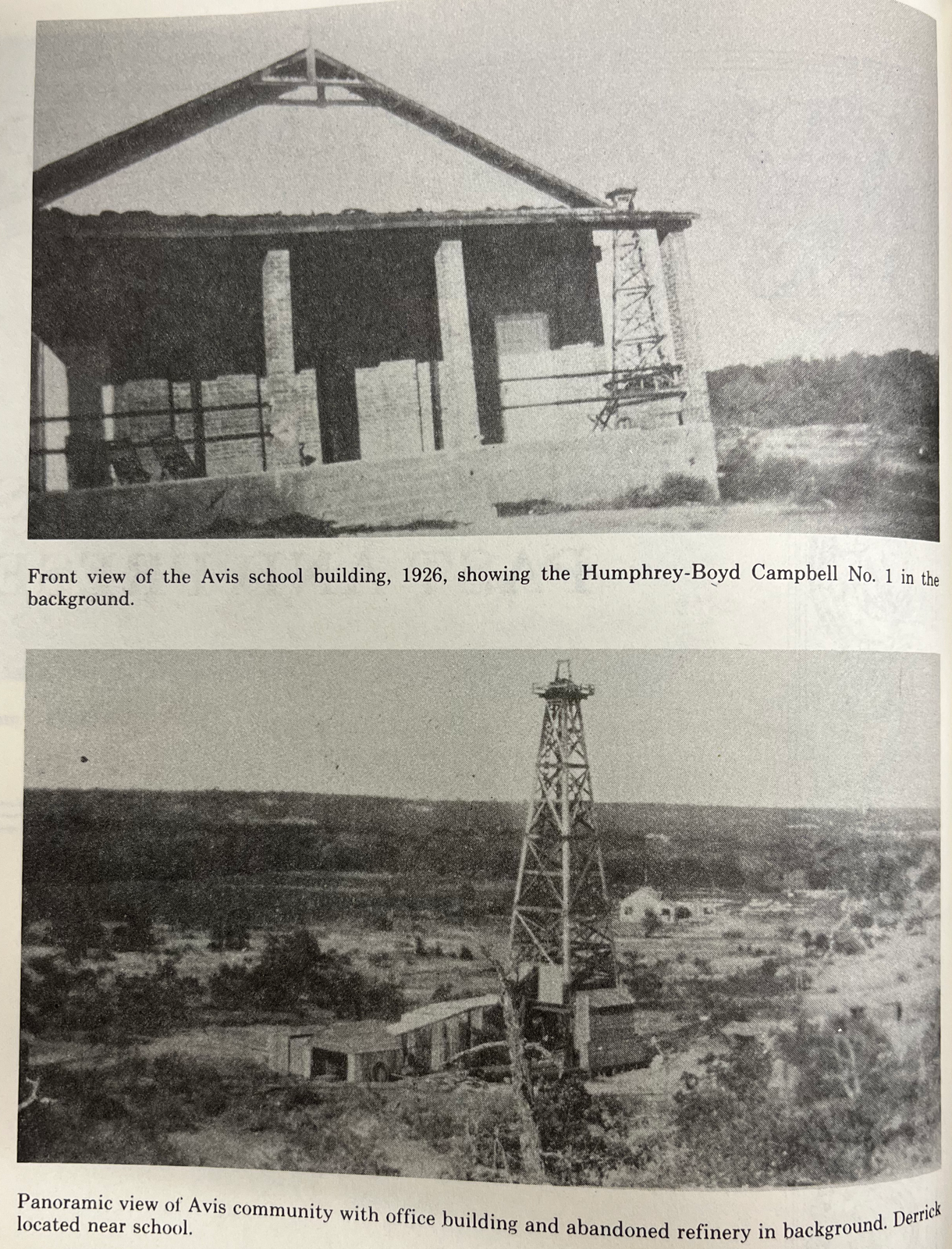
The Avis School was in existence from 1915 to 1980. Built by the Avis-Wood Oil and Refining Company workers and originally intended for the benefit of their children, very few refinery families were still around after 1918.
The Avis Community and Avis School took their names from James David Avis of Wichita Falls, the originator and President of the Avis-Wood Oi)l and Refining Company.
William T. Wood, co-owner and Vice-President of the refinery donated land for the erection of a school building, June 28, 1915. The school was built and ready for classes in the fall of that year. It was in District 66 and designated as a grade school, with grades one through seven.
The school building was exceptionally nice for a one-room country school. It had concrete floors, front porch and front steps. The exterior was brick and it has a tar roof. Each year, the men of the community would gather, heat asphalt and pour it on the roof to keep it from leaking, smearing it on with push brooms.
It served as a Community Center as well as school. On Sundays, it was Church and Sunday School and sometimes, Gospel Singings. There were pie suppers, box suppers, ice cream socials, Easter-egg hunts, Christmas get-togethers, school board meetings, etc., but the best of all were the "Literaries," or play nights. The programs were made up of whoever in the community could recite a poem, sing a song, dance a jig - or whatever - along with the well-rehearsed school children. And their programs, on occasion, included a skit of some kind. These Literaries were presented to "Standing Room Only" audiences, as people came from other communities such as Pudden Valley and Burton Springs to enjoy the entertainment. The big double doors in the back of the building would be thrown wide open and those who couldn't get in stood outside, craned their necks, and looked in. These activities prevail- ed from the start of classes in 1915 and continued on until 1930.
On July 12, 1930, the Avis School was consolidated with the Post Oak School District, after which time Avis children rode a school bus into Post Oak. The last school year for Avis School was in the fall of 1930 and spring of 1931.
In the 15 years of classes in the Avis School, only ten teachers taught there: (1) Esther Sanders, 1915-16 and 1916-1917; (2) Grace Lamar, 1917-18; (3) Mary Hilton, 1918-19; (4) Eugenia Johnson, 1919-20; (5) Georgia Lelach, 1920-21 and 1921-22; (6) Nell Morris Pults, 1922-23 and 1923-24; (7) Eva fell Teague, 1924-26; (8) Camile Bird, 1925~26 and 1926-27; (9) Lula Williams Ellis, 1927~28 and (10) Opal Smith, 1928-29, 1929-30 and 1930-31.
List of pupils, and there may have been others: Lillie, David and Alfred Brisco; Louise, Helen and Oleta Campsey; Flora and Maudie Catlin; Bertha and Eugene Echelbarger; Clifford Edmiston; Burleson and Bluford Finch; Virgil, Elma, Oleta and LaRue Finch; Alton Franklin; Earlene, Hazel and Thurman Graves; LeRoy Grimmett; Arvil and Bill Kennedy; Lula and Katherine Lindsey; Lois and Jim McAnear; Buddy McAnear; Roy Moody; LeRoy and Loy Nichols; Ruby Nipper; Roy and Vanda Pierce; Ida Mae Reeves; Pauline and Christell Reeves; 8918
J.T., Warren and Junior Rummage, Melvin, Zella and Alvin Rummage; Lester E. Smith, Flay Dell Stevens; Dovey Taylor; Ethel, Lizzie, Verdie, Stella, Eddie and Doyle Walton; Evelyn Wasson and Fay Woods.
For information on teachers at the Avis School look in the Family History Section for Esther Sanders, Grace Lairner Foxhall, Mary Hilton Whiteside, Eugenia Johnson Duncan, Georgia Leach Bryant, Nell Morris Pulte, Eva fell Teague Taylor, Camille Bird Bearden Russell, Lula Williams Ellis and Opal Smith Bell.
Avis-Wood Oil and Refining Company
Had there been an abundant supply of oil reserves in the Stinehouse pool, there might have been a thriving town located ten miles north of Jacksboro by the name of Avis. The townsite was already staked off, streets named and the Master Plan called for a luxury hotel to be built on top of Dead Man Mountain.
Had all the high hopes and bright dreams materialized for those who had the ambition and courage to build a $150,000 refinery near the Stinehouse wells - the first oil found in Jack County - the world might have beaten a path to their door. Unfortunately, it was not to be. The refinery operated for only three years.
The decision to build a refinery near the Stinehouse wells was made on the strength of the high grade oil found there. The Avis-Wood Oil and Refining Company was incorporated July 15, 1914, with J.D. Avis of Wichita Falls, Texas, President and W.T. Wood of Kansas City, Missouri, Vice-President. Frank E. Wells of Columbus, Ohio, who patented the "Process of Refining, Fractionating and Reducing Oils," was architect and Superintendent of the refinery while it was under construction. He drove a fancy Hupmobile, and was the first tenant in the office building.
My dad, Jesse F. Finch, was hired as a roustabout in August, 1914. He pumped the Stinehouse wells, painted oil storage tanks, rode with three other men on a drag behind their autotruck to smooth roads after the rains, and performed many other duties associated with the building and operation of the refinery.
Several families from Jack County and surrounding areas came to join the work force, in addition to four or five families who came from Ohio with Mr. Wells.
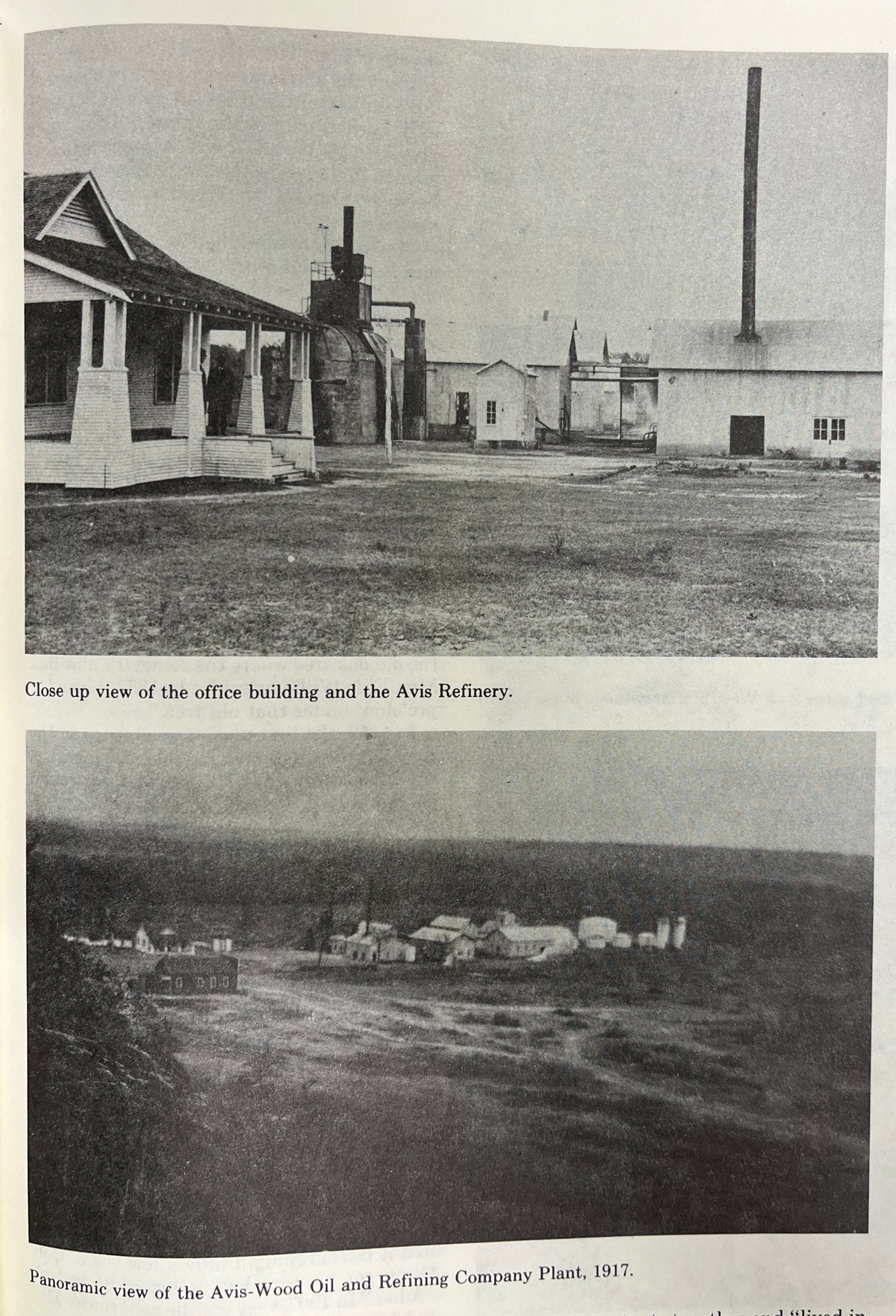
There were three buildings in the Avis complex besides those that housed the refinery equipment - the office building, store building and school house. The first two were built in 1914, the last in 1915. Living quarters in the office building were occupied by executive personnel and their families. W. T. Wood built the store building, retaining a small back room for himself and he made a company store out of the rest of it. All other refinery workers and their families lived in tents. As a rule, these tents had wooden floors, wooden walls and tent tops. Some folks placed two tents together and "lived in style."
Construction was begun in the summer of 1914 and it took a year to complete. In that time right-of-ways were obtained for pipe lines, telephone and telegraph lines. Until the refinery acquired their big two-ton autotruck - the first truck in Jack County - all their hauling was done by W.B. Isbell and his ox team. These animals were incredibly strong, no job too heavy for them. But they were also incredibly slow.
First run of the refinery was around August 1, 1915. The chief product was a high grade motor oil bearing the trade name "Avisco." On November 4, 1915, headlines on the front page of the Jacksboro Gazette proclaimed, "Avis-Wood Oil Refinery Now Operating."
The refinery created lots of excitement. It became a popular pastime for sight-seers to drive out and look it over, some from as far away as Wichita Falls and Oklahoma City. Then unexpected things began to happen.
On May 11, 1916, the Jacksboro Gazette announced, "Shallow Wells At Avis Being Worked Over." A "man who knew his business" was hired to work over the shallow wells near the refinery. However, try as he might, the "new man" was unable no make the wells recover their peak production, and the reserves were soon depleted. I remember hearing my mother say they "had to ship oil in from as far away as Salt Lake City to have something to refine."
They had counted on the railroad building a spur from Jacksboro to the refinery for shipping supplies in and products out, regardless of weather conditions. All the refinery had to depend on for transportation was their big auto-truck, which was useless during high water times. But the railroad never came.
The refinery was shut down m 1918 and most of the families moved away. Early in 1919, people were sent in from elsewhere to tear it down. The old concrete foundations can still be found where the Avis-Wood Oil and Refining Company once sat beside Crooked Creek in the Avis Community; the office building is still being used as a private residence; the store building was moved to another part of the county where it became a country church and the school house was torn down many years ago, leaving only the foundation and front steps.
by LaRue Finch Davison
Image
Source Description
History of the Avis community and school
Description/Transcription